
Hunt for Red October | The USSR’s Premier Chocolatier
Red October (Krasny Oktyabr) may well be associated with the October Revolution of 1917 or the fictional movie starring Sean Connery as a Russian submarine commander; however, for countless children and adults growing up in the Soviet Union, it was something a whole lot more important. Red October was to become synonymous with the Union’s best-selling confectionery.

Red October was a Willy Wonka for the communist masses, producing toffees, candies, hard-boiled sweets, and chocolate. But the history isn’t as red as the name would have us believe; read on to learn a little more about the history of these soviet treats.
Origins
Red October was founded many years ago when Theodore Ferdinand von Einem, a German citizen, travelled to Moscow to make his fortune. Theodore arrived in Moscow in 1850 at the age of 26, initially selling sawed sugar. Seeing an opening in the market and understanding the Muscovites’ sweet tooth, Theodore then opened a small shop on Arbat Street.
Even in the 19th century, Arbat street was a great place to be, and Theodore’s high-quality chocolate and sweets soon became a popular sold under his name Einem. Theodore would also supply sweets to the soldiers on the front during the Crimean war, which allowed him to move to new larger premises on Myasnitskaya Street.
Theodore’s business was about to grow even further when he met fellow German, Julius Heuss. Julius may not have known a lot about candy, but he was an astute businessman, and in 1857 the two partnered up; another branch of Einem candies opened on Teatralnaya Square. Theodor and Julius then used capital to buy the latest candy-making equipment from Europe. In 1867, the two men built a three-story factory on the Moskva River’s Sofiiskaya Embankment; as the business grew, this was extended to the Bersenevskaya Embankment.


With the new machines and factories, Theodore gave Moscow what they wanted, and a wide range of confectionary was produced. Hard-boiled sweets, candies, chocolate, pastille, cookies, biscuits, gingerbread and glazed fruits were just some of what the now popular Einem candies turned out.
Unfortunately, not long after the new factories were operating, Theodore Ferdinand von Einem decided it was time to return to Germany; after reaching Berlin, he sadly passed away. In his will, it was written that he be buried in Moscow, so in 1879, he was returned and laid to rest in Vvedenskoye Cemetery. After all of the years, Theodore Ferdinand von Einem hasn’t been forgotten, and fresh flowers are regularly laid at his grave.
As for Einem candies, the name remained, and Julius Heuss remained at the helm until his eventual death in 1907.
The Model Factory
From its outset, Einem Candies was seen as a great business; this may well be in part due to its slick marketing and advertising, but it was also to become well known for its charitable work and the excellent treatment of employees.
Throughout its history, Theodore always supported charitable causes. One of his early campaigns was to donate five kopeks of silver to charity for 1 pound of cookies sold.

In Moscow, Einem candies opened educational facilities for children who would later become apprentices, granted pensions to employees who retired after a minimum term of 25 years and created a health insurance fund to aid those who needed it.
As many of the factory workers came from remote villages, accommodation and meals were supplied. Even after its two founders’ death, Einem Candies continued its charitable work; during the First World War, it established a field hospital to treat the wounded and delivered free cookies to the soldiers fighting on the frontlines. For a factory during the Russian imperial period, this was revolutionary, that is until October 1917!
The Birth of Red October
After the October Revolution of 1917, Lenin‘s Bolsheviks were on their way to taking Russia, and the world would eventually see the birth of the Soviet Union. As for Einem Candies, it was to be rebranded in line with its nationalisation given the name of ‘State Confectionery Factory no.1, formerly known as Einem’.
Even the Bolsheviks were worried that people would forget the success of Einem Candies! State Confectionery Factory no.1 wasn’t to last, and when Russia was firmly in the grip of the socialists, a more suitable name was selected, Krasny Oktyabr (Red October). The name Red October would stick, and even now, almost 100 years later, Red October remains Russias favourite.
The War Years
With the onset of World War Two ( the Great Patriotic War), many Russian companies began to retool and provided support for the war effort; Red October was no different. The factory at the heart of Moskow was ideally situated for supply. Red October produced flame arrestors (safety device) for aircraft, coloured smoke grenades for the navy, porridge, and high concentrate chocolate for the Airforce and submariners. All of this earned the factory further awards for helping the country achieve Victory and further cemented its place as the peoples favourite.
After the War
After World War 2, as the Soviet Union moved forwards, so did Red October, its production plant on the Moskova River rose another two storeys. As Red October grew, it incorporated new machinery within the plant producing new candies such as boiled sweets; it even began experimenting and trialling new sweets and flavours, which led to the company winning various awards for innovation.
Alyonka
It wasn’t until the 1960’s that Red October was to launch a product that would become so iconic that all throughout the Soviet Union would recognise the brand immediately.
In the world of chocolate, the British Dairy milk glasses and the simplistic, bold print of America’s Hersheys were about to be joined by Alyonka.

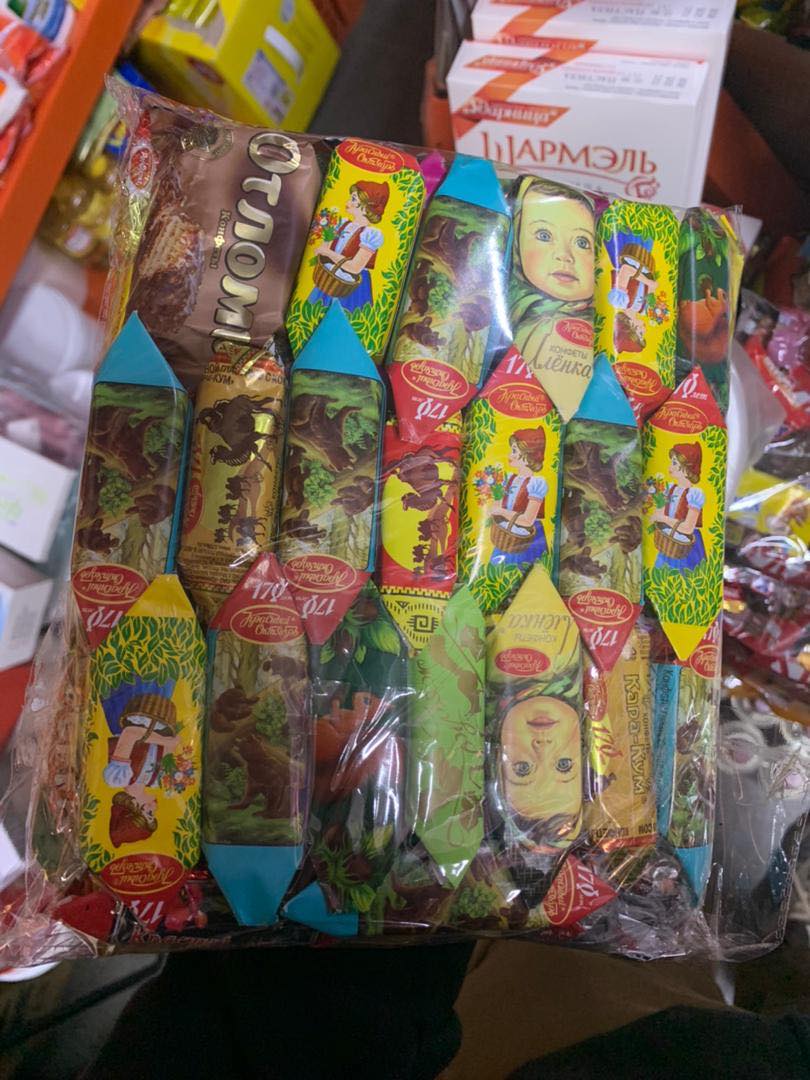
Alyonka is a young chubby-cheeked, blue-eyed infant found on the wrapper of Red October’s best selling bar of chocolate Alenka. During the 1960s, there was a drive to mass-produce an affordable yet delicious milk chocolate bar. In 1964, the Soviet Union’s led confectioners at the Red October Chocolate factory had their breakthrough.
With the Chocolate bar ready to go, all that was needed was a suitable wrapper for Alyonka. For a while, differing children and ladies we used until the newspaper “Evening Moscow” held a competition to find the most suitable image for the Alyonka brand of chocolate. Alexander Gerinas eventually won the competition with a photograph of his eight-month daughter Lena.
Modern-Day Success
The Soviet Union is no more, and although the actual Meaning of Red October may well have been forgotten, the brand lives on. Travel anywhere in the countries of the former Soviet Union and those of its allies, and you’ll be sure to find a bar of Alyonka chocolate and a mixture of loose sweets sporting the (Krasny Oktyabr) logo.

After the Union’s demise, Red October (Krasny Oktyabr) was to be reprivatised in 1993. Red October would eventually be one of the few business transitions from the communist Soviet Union to the western capitalist way. Suddenly sweets such as Kis-Kis (Puss-Puss), Rakovye Sheiki (Crayfish Necks), Alionka, Skazki Pushkina (Pushkin’s Fairy Tales), Slava (Glory) and Koniok Gorbunok (Hunchback Horse); would have to compete with Mars bars, Twix, bounty bars, Hershey’s kisses and Snickers.
It turns out that it was an easy step for a company once named after its founder, a simple German immigrant with a brilliant idea. This company supplied chocolate to the Csar, Lenin and Stalin; it also survived two world wars and an even longer, colder war. It endured a transition from Capitalism to Communism and back again. Theodore Ferdinand von Einem started making his candies with natural ingredients and no additives. Now here we are; over 160 years later, production has changed, and the name, although Red October, still insist on using only natural ingredients, which is one of more reason that this Soviet legend is now a multi-million dollar company.