North Korea (DPRK) Tours

Explore the self-proclaimed ‘Socialist Paradise’ of North Korea

All North Korea Tours

Country Overview

Pyongyang: The Heart of the DPRK


Pyongyang, the capital of the Democratic People’s Republic of Korea, sits on the Taedong River in the western half of the country. The river flows through the heart of the city and out into the West Sea (Yellow Sea) at Nampo.
The capital city is the heart of the country – most of what you have seen and heard about North Korea will be from Pyongyang. From the stunning monuments in the city centre to the pastel-coloured buildings which dominate the landscape of east Pyongyang, this city truly has to be seen to be believed.
As well as being the home of the world’s largest stadium, the Rungrado May Day Stadium, and the world’s tallest stone tower, the Juche Tower, the city is also a hub of culture. Why not spend a sunny afternoon at the Munsu Water Park, or relax one evening with a game of bowling and a beer at the Golden Lane Bowling Alley. There are even 2 or 3 funfairs and amusement parks dotted throughout the city which make for an exciting evening in Pyongyang.

Highlights


Mansudae Grand Monument
Sitting in the centre of the city, these 22-metre high bronze statues depict the country’s leadership. On the left, the President Kim Il Sung. On the right, General Kim Jong Il. Originally built in 1972, the monument was centred around a single statue of President Kim Il Sung. It was updated in 2011 after the death of General Kim Jong Il to include the younger leader, as well as updating the former statue design.

Tower of the Juche Idea
One of the most noticeable structures in the city, the Juche Tower commemorates the national ideology of ‘Juche’, meaning ‘self-reliance’. Visitors can head up to the top for stunning views of the city. The red flame atop the world’s largest stone tower glows at night; the red flame is a symbol that can be seen throughout the country to symbolise Juche.

Pyongyang Metro
The bustling metro system beneath Pyongyang is truly a sight to behold. The network is one of the deepest in the world, with grand architecture which puts all other country’s stations to shame. Running a mixture of both old classic vehicles and new domestically produced high-tech metro cars.


Of course, there is so much to do and explore in Pyongyang that it’s not even possible to include all the highlights on this list! The only way to really scratch the surface of Pyongyang is to visit.

Kaesong & DMZ: The Frontline of the Korean War


The southern-most city in the Democratic People’s Republic of Korea is the city of Kaesong just north of the Korean Demilitarised Zone, or DMZ, which has marked the division between north and south since the Korean War armistice was signed in 1953. The city, which was originally part of South Korea before the war, was spared much of the bombing during the conflict allowing the old city to be preserved to this day.
The most famous part of the DMZ is not far from Kaesong; the Joint Security Area is the site where the two sides stand face to face and visitors may get the chance to enter one of the three blue huts which span the border and ‘technically’ cross into South Korea.
Further down the DMZ, and only a short drive from Kaesong, is a military lookout where visitors can look over the man-made wilderness of the DMZ and potentially spot the infamous ‘Concrete Wall’ built by the Americans on the southern side of the border, something which has greatly dismayed the northern side as it is seen as a physical symbol of national division.

Highlights


Panmunjom, DMZ
Perhaps the most famous site in all of Korea, a visit to the Joint Security Area at Panmunjom is integral to understanding the Korean Peninsula as a whole, and North Korea in particular. A visit here also includes a stop off at the village where the armistice was signed which was been turned into a museum.


Kaesong Koryo Museum
Situated in the grounds of an old Confucian school, the museum displays various artefacts from the area from the Koryo dynasty period as well as hosting a small stamp exhibition, a great spot for grabbing small souvenirs and trinkets.


Tomb of King Kongmin
One of North Korea’s many UNESCO World Heritage sites and one of many royal tombs dotted around this region. The tomb was built for the 31st King of the Koryo Dynasty, King Kongmin, who died in 1374. His Mongolian wife is also interred in the tomb.

North West: A Land of Rivers, Mountains and Valleys


The North West of the DPRK is home to some of the country’s smaller, yet uniquely interesting cities as well as some of the most intriguing attractions in the country. The region is comprised of two provinces, South Pyongan Province & North Pyongan Province of which the capitals, Pyongsong and Sinuiju respectively, are both visitable by tourists.
The city of Pyongsong is not far north of Pyongyang and is a hub for the science and technology industry. Meanwhile, in the far north, the city of Sinuiju sits on the banks of the Amnok River border opposite the bustling Chinese city of Dandong. Both cities have their fair share of interesting attractions, from visiting local schools in Pyongsong to touring a cosmetics factory in Sinuiju and much more.
Perhaps the most famous site in the region is buried deep within the Myohyangsan Mountain Range; the International Friendship Exhibition. This stunning exhibition contains gifts from foreign leaders, governments and organisations all stored deep within the region’s mountains. A visit here is also an opportunity to hike through North Korea’s internationally famous natural landscape.

Highlights


International Friendship Exhibition
This stunning exhibition, deep in the mountains, houses the thousands of gifts sent to the President Kim Il Sung and General Kim Jong Il over the years. Whilst exact figures are unknown, some suggest the exhibition holds up to 220,000 gifts ranging from the usual to the very unusual. It’s also possible to hike the surrounding Myohyangsan mountain region.


Pyongsong
Not far north of Pyongyang, Pyongsong was founded in 1969 as the sci-tech centre for the whole country. There’s plenty to do in and around the city, including visiting the local schools, exploring the Konji-ri Revolutionary Site from where Kim Il Sung commanded his army during the Korean War and an original 6th-century Buddhist temple.


Sinuiju
This small city is the provincial capital of North Pyongan Province, sitting on the banks of the Amnok River which separates China and North Korea. Visitors entering the country by train will stop at the local Sinuiju station for a customs check before moving on, but for those visiting the city, the local Sinuiju Folk Park and Sinuiju Kindergarten are must-see attractions.


Anju
A rarely-visited city between Pyongsong and Myohyangsan, Anju is an industrial city set on the Chongchon river. Visitors will get a chance to see the ancient city walls as well as the beautiful Paeksang Pavilion, once considered the most beautiful in the region. An ideal rest stop on the way up to Mt. Myohyang.


Hoechang
Visiting this city is a very different experience from any other. Originally a base for the Chinese Volunteer Army during the Korean War, it is the resting place of Chairman Mao’s son who died during the conflict.

East Coast: The DPRK’s Glistening Eastern Seaboard


The East Coast of North Korea is perhaps one of the most diverse and incredible parts of the country. In the south, the Kumgangsan region, known as the Diamond Mountain, dominates the landscape; mountains and valleys offer incredible hiking opportunities with a view of some of the best natural scenery in East Asia.
Moving northwards, the coastal city of Wonsan is a hub of activity. Not only is it a fully functioning city and an operational eastern seaport, Wonsan is the hub of North Korea’s first major foray into becoming an international tourism destination. The Wonsan Kalma Resort Project has seen the development of sandy beaches, a ski resort inland from the coast, and so much more. Along with this, the city is a tourist hotspot for local North Koreans so it’s a great opportunity to see locals enjoying their time off.
Even further north, the city of Hamhung, combined with its neighbour Hungnam, make up the DPRK’s second-largest urban area. A centre for the chemical industry, a visit to the Hungnam Fertiliser Factory gives a glimpse at the heavy industry which dominates the local economy in this city. From Hamhung, visitors can travel to see the Pujon Highlands, one of the ‘8 Wonders of Korea’.

Highlights


Jangdok Island & Lighthouse
A chance to look out over the East Sea (Sea of Japan). A walk out to the island makes for an enjoyable evening stroll and serves as a chance to chat with local fishermen who congregate on the island hoping for a good catch.


Songdowon Schoolchildren’s Camp
A real throwback to the days of the Soviet Union. The Schoolchildren’s Camp at Songdowon was built for Korean and international students to be taught about socialist values whilst also learning valuable life skills; imagine a kind of socialist scout camp. Amazingly, the camp is still fully operational!


Kuryong Waterfall
A trip to Kumgangsan would not be complete without a visit to the famous Kuryong waterfall. A round trip hike encompassing 8km will take you past this incredible natural wonder and give you a chance to take in some fresh air during your visit to Korea’s most stunning region.


Hungnam Fertiliser Factory
“Fertiliser is rice, and rice itself is communism!” is a quote from President Kim Il Sung when he visited this factory. A tour of this factory includes various different control rooms and facilities, as well as demonstrating the heavy industry which powers the national economy.

South West: Where the DPRK Meets the West Sea


The DPRK’s two largest West Sea ports are located in the South West of the country. Nampo is the port city built to serve Pyongyang, located at the mouth of the Taedong River. Due to Nampo being a fully operational port city, there is little to do in the city itself, although just down the road sits one of the largest engineering marvels in the country, the West Sea Barrage. The surrounding area offers a pleasant mix of heavy industrial plants such as the Chollima Steelworks and the Tae’an Glass Factory as well as local collective farms, historical tombs and scenic lookouts, all open to foreign visitors.
The second major port on the West Sea is located at Haeju in the far south of the country. Due to its proximity to the Northern Limit Line (the de-facto North-South border in the West Sea) the city has been designated a ‘Frontline City’. Rarely visited by tourists, Haeju offers a glimpse of real-life in the DPRK as well as many historical sites dotted around the surrounding countryside.
The city of Sariwon is the provincial capital of North Hwanghae Province and a handy rest stop on the Unification Highway between Pyongyang and Kaesong. A stop here will likely include a chance to try some homemade ‘Makkoli’, a traditional Korean rice wine, and a walk up a hill to a lookout from where most of the city can be seen.

Highlights


West Sea Barrage
Built between 1981 and 1986, the West Sea Barrage is an 8km-long dam at the mouth of the Taedong River. It was built to provide fresh water to the surrounding regions as well as to irrigate local fields. It is considered one of the greatest engineering marvels in the DPRK.


Chollima Steelworks
A chance to visit an operational factory producing steel, although more importantly, this site is considered the birthplace of the Chollima Movement. A 1950s initiative enacted by Kim Il Sung to boost the national economy at ‘Chollima Speed’ (referring to a mythical winged horse present in Korean mythology).


Koryo Fortress
This fortress dates back to the Koryo dynasty, highlighting the historic military importance of the area surrounding Haeju. The fortress is built atop the 120-metre Suyang waterfall providing stunning views of the surrounding area. The region in which it is set, South Hwanghae, is often referred to as the ‘bread-basket of Korea’ due to its capacity for efficient agriculture.

Mt. Paektu & Samjiyon: Korea’s Sacred Birthplace


Paektusan, the White Head Mountain, is the highest point on the entire Korean peninsula and sits on the border between the DPRK and China, where it is known as Changbaishan. The mountain which is, in reality, a supervolcano, has a large lake inside its caldera known as ‘Heaven Lake’. Paektu is one of the most important symbols of Korea in general, as well as North Korea in particular.
The mythology surrounding the mountain describes the birth of the first King of Gojoson, Dangun, being born at the mountain. In more recent times, Korean anti-Japanese guerrilla fighters operating in northern Korea used the mountain and surrounding area as a base of operations. One of the major tourist sites in the region is the Paektusan Secret Camp, where the General Kim Jong Il is said to have been born.
The region is reachable by charter flight into the nearby city of Samjiyon. The city has recently been renovated making it more hospitable to visitors with the construction of a new hotel and ski resort. The major attraction near the city is the Samjiyon Grand Monument, one of three ‘Grand’ monuments in the country. The monument is dedicated to Kim Il Sung’s anti-Japanese guerrilla operations during the 1930s and 40s.

Highlights


Mt. Paektu
A trip to this region will always be centred around a trip to the peak of Paektusan. Hop on the funicular railway and scale the rocky terrain up to the edge of Heaven Lake, looking out over the water to the border with China. The mountain, known as Changbaishan by the Chinese, is one of the most sacred sites in all of Korea – the home of the mythological leader Dangun of Korea, and more recently, the official birthplace of General Kim Jong Il.


Samjiyon Grand Monument
This monument is, in fact, comprised of numerous statues and monuments, all centred around a bronze statue of the President Kim Il Sung in his younger years, dressed in his military uniform.


Mt. Paektu Secret Camp
The official site of the birth of the second leader of the DPRK, the General Kim Jong Il. The secret camp at Paektusan was the headquarters of the anti-Japanese revolution. Many of the log cabins still remain at the site or have been recreated for the purposes of education and tourism.

North East: Unseen North Korea


North-eastern North Korea is one of the least visited parts of the country by foreign visitors. The province of North Hamgyong is reachable primarily by flight into Orang Airport. From here, visitors can drive northwards to the provincial capital, Chongjin, the scenic beauty spot of Chilbosan, or the small city of Kyongsong where travellers can spend a day at the health spa, or admiring the views out over the East Sea.
Chongjin, known as the ‘City of Iron’ due to the prevalence of heavy industry in the city, is the primary destination for tourism to this region. The enormous Kimchaek Steelworks dominates the skyline, while the city’s harbour plays host to dozens of fishing boats coming and going every hour as they head out for work in the East Sea.
Outside of Chongjin, there are 2 major cities that foreigners can access – Hoeryong & Rason. The former is the birthplace of the wife of the President Kim Il Sung, Comrade Kim Jong Suk. Her birthplace is now a revolutionary site, and a bronze statue of Kim Jong Suk towers over the city centre. Rason, on the other hand, is not really a city at all, but two cities, Rajin & Sonbong. Together they form the ‘Rason Special Economic Zone’ or ‘Rason SEZ’. This area was created to experiment with a free market and shows a different side to North Korea that is very similar, yet completely different to the rest of the country. From Rajin, travellers can catch the international train to Vladivostok in Russia.

Highlights
Chongjin Trolley-bus
Why walk around the city when you could ride in style on one of Chongjin’s Trolley-buses? The network is the nation’s only trolley-bus system outside of the capital city, Pyongyang. The bus offers a unique way to travel the city, taking in a brief sense of everyday life in Chongjin.


Chilbosan Homestay
‘Mt.Chilbo’ or ‘Chilbosan’ means ‘Seven Treasures Mountain’ and is one of North DPRK’s most beautiful natural landscapes. On top of this incredible beauty, this is the only chance for foreigners to stay in local homes. The Chilbosan homestay is a must-visit for anyone looking to get a real understanding of daily life in North Korea.


Wangjaesan Grand Monument
North Korea only has 3 monuments considered ‘Grand Monuments’. One in Pyongyang, One in Samjiyon and one at Wangjaesan at the far north-eastern tip of the country. Accessible from Hoeryong, this monument stands out from its flat surroundings and sits right on the border with China. It was built to commemorate the 1933 Wangjaesan Conference.


Rason City Market
Experience a genuine marketplace in North Korea! Wander through the hustle and bustle as local traders sell domestic, and foreign goods (mostly exported from China) and pick up a souvenir or two.

Visiting North Korea

A trip to North Korea, or the DPRK as it is officially known, may seem from the outside to be a risky adventure – but, as with most things North Korea-related, these fears are massively overhyped. That being said, it’s worth being clued up on what to expect when you arrive in Pyongyang for the first time.
As with all countries you visit, respecting the local culture is important and this is more true in North Korea than in most places. It’ll be hard to miss the symbols of the country’s ruling ideology, Juche, and the common portraits of the Great Leaders which adorn the outside of every major public building in the city. For a first time visitor, the reverence and respect for the national leadership, government and ideology may be jarring, but it’s important to be aware that the Koreans feel very strongly about their national identity, and so respect for the local culture and customs should be borne in mind.
That being said, your local guides who will greet you at the airport or train station upon your arrival are very familiar with foreigners and happy to welcome all international travellers, so you’ll be in extremely capable hands.

Rules & Regulations

As with many countries around the world, there are a few simple rules to follow during your trip to ensure you don’t accidentally cause any offence or get in trouble. Before your tour, we’ll run through the rules in your pre-tour briefing so you’re fully aware of what you can, and can’t do. Some of the most important rules are:
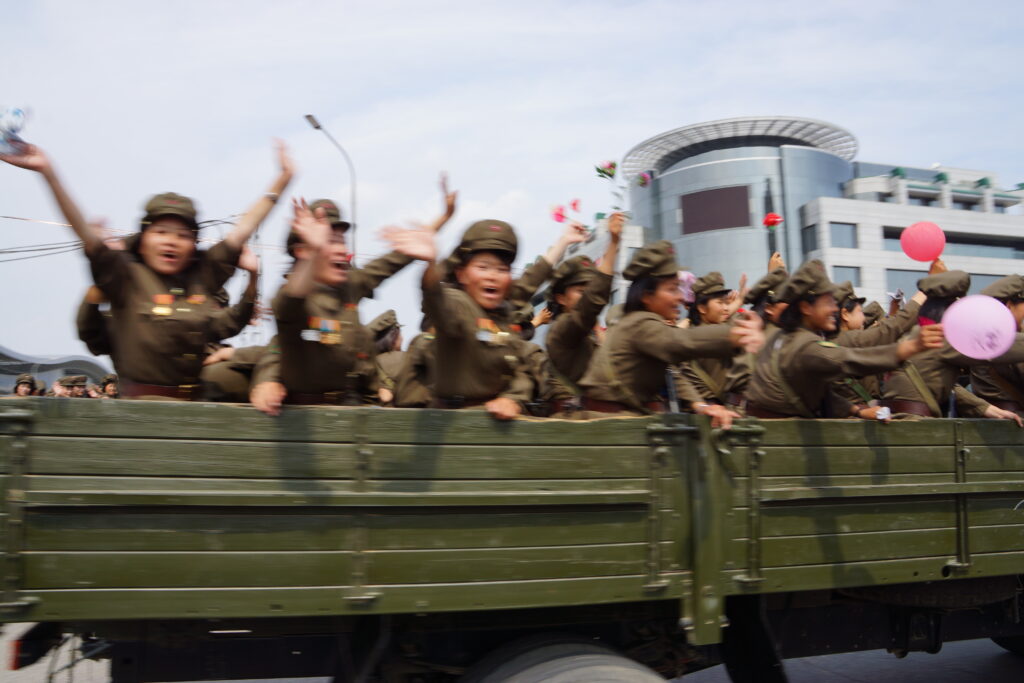
No Photos of the Military – the Korean People’s Army is ever-present in towns, cities and the countryside in North Korea. However, photos of military personnel, checkpoints or installations are not permitted. This rule does not include photos of the DMZ border with South Korea.
Photos of the Leaders – during your trip, you’ll likely visit statues of the President Kim Il Sung and General Kim Jong Il at some point, or at least see murals and paintings around and about. Make sure, if you’re the photographer, to get the whole image in the frame and nobody is blocking the image.
Follow Your Guide – As a tour group, the guides are responsible for our activities. So if a guide tells you not to cross a road or go into a building, then don’t.

Arrival & Departure

There are two main ways to enter North Korea. Most visitors travel from China on an Air Koryo flight to Pyongyang, or via international train from Beijing, Shenyang or Dandong.
Other options such as flights from Shanghai, Shenyang, Vladivostok or Dandong are also available. It’s also possible to cross the border from Russia by train near Vladivostok and from China by road at Tumen City.
For the best experience, we recommend taking the train into Korea, and flying out. From Beijing, the 24-hour train journey to Pyongyang is split into two parts; an overnight sleeper train to the Chinese border city, Dandong, followed by a 6-hour North Korean train from Sinuiju to Pyongyang.
International flights always operate from Pyongyang’s Sunan International Airport. There are also Air China flights running the Pyongyang-Beijing route – these can be used in circumstances where Air Koryo is not operating on a desired date. The flight-time between Beijing and Pyongyang is 2 hours on average.
For more information on arriving and departing North Korea, as well as more information on other ways to cross the border, feel free to get in touch.

Travelling in North Korea

When travelling around the capital, you will usually travel by tour bus between locations; although it is possible to walk, or even cycle, around some parts of the city. Visiting other parts of the country is also usually done via tour bus, although areas in the far North and North East are only really accessible by plane.
Air Koryo operates regular domestic flights which are open to foreigners, although some cities are only accessible by chartering an Air Koryo aircraft; this may also be the case if your tour schedule requires flying on a day when domestic flights are not operating.
It is also possible to see parts of the country by train. The border city of Sinuiju is accessible by train – most visitors who enter or leave the country by rail will pass through Sinuiju for their customs check. On some days, the railway line from Pyongyang to the Rason Special Economic Zone on the Russian border is open to foreigners – although this can often be a multi-day journey ending in Vladivostok which connects to the Trans-Siberian Railway.

A North Korean Group Tour

Most people who visit North Korea do so on an organised group tour. We operate a variety of group tours all year round catering to every intrepid traveller. Our shorter, budget tours make sure to hit the highlights of Pyongyang and the Inter-Korean Demilitarised Zone whilst our standard tours venture out across the country to some of the lesser-seen cities.
Many people who travel to North Korea on a group tour may not have ever been on a group tour holiday before; we understand it isn’t everybody’s cup of tea – although many would-be solo travellers find that they enjoy the company during their trip.
For those looking to see as much of the country as possible, a group tour is your best option since larger groups mean a lower cost per person; a saving that we pass straight on to you. You can find all sorts of group tours on the website ranging from Festival Tours and Specialist Tours to Budget Tours and Short Tours. If you have any questions regarding how to book or what to expect on these tours, feel free to get in touch.

A North Korean Private Tour

An independent tour to North Korea could be exactly what you’re looking for if you prefer solo travel or have a clear, specific idea of what you want to see. We can organise a private tour to North Korea in next to no time; all we need to know is the number of people travelling with you, where you want to go, and what you want to see and we’ll work with you to draw up an itinerary that fits your requirements.
If you’re travelling from Beijing, we’ll meet you in person to explain the details of your trip as well as deliver the all-important pre-tour briefing, which gives you a chance to ask any questions you might have. Often, independent travellers are happy to travel without a western tour leader, meeting their Korean guides for the first time in Pyongyang. However, for a small additional cost, one of our tour leaders will be happy to accompany you on your trip.
For more information on independent tourism to North Korea, get in touch now and start planning your adventure!

Latest North Korea Blog Posts

Visiting Kumgangsan | Travel to North Korea

This is one of the most beautiful regions on the Korean Peninsula. Korea often calls itself the ‘Land of Morning Calm’ and looking at the landscape here in the Kumgang region, it’s not difficult to see why. It’s also not difficult to understand why tourists, both foreign and domestic, flock to Mt Kumgang to enjoy […]

Visiting Kaesong | Travel to North Korea

Today, if you think about travelling to Korea, you’ll probably think about Pyongyang. These days, this bustling city on the Taedong has some of the country’s most well-known monuments and landmarks. But, if we travel back over a millennia, the political centre of the Korean peninsula sat 130km to the south. During the Koryo dynasty, […]

Liberation Day | North Korean Holidays

In North Korea, the 15th of August is celebrated as Liberation Day, officially ‘Day of the Liberation of the Fatherland’ (조국 해방의 날). It is one of the country’s most important public holidays, and is celebrated both in North Korea, and in the south of the peninsula. The holiday marks the end of Japanese rule […]