
The Ekranoplan & The Caspian Sea Monster
The Ekranoplan Programme 1966 – 1990s
During the 1960s, the Soviet Union began development on a truly monstrous vehicle, capable of travelling over water at 550 kph (342 mph) and transporting incredible amounts of cargo incredibly efficiently.
Not quite a ship, not quite an aircraft, this new vehicle was a new type of experimental high speed transport which took advantage of a niche quirk in aerodynamics; the Ground Effect.
Officially dubbed ‘Ground Effect Vehicles’, the Soviet Union’s prototypes took the name ‘Ekranoplan’.
What is an Ekranoplan?
The basic principle of the Ekranoplan was discovered decades before the 1960s. For years, pilots had realised, when landing, their aircraft tended to suddenly generate more lift, seemingly out of nowhere.
This phenomenon is called the Ground Effect, created when a fixed-wing aircraft flies close to a solid surface.

A wing generates lift by passing forward through the air and forcing it downwards. When this fast moving air hits the surface, it increases the air pressure beneath the wing creating additional lift. This means, large aircraft don’t need to be travelling at incredibly high speeds to lift slightly off the ground.
It was this aerodynamic principle which led to one Soviet designer to pursue a fantastical new technology. This visionary designer was Rostislav Alexeyev.
Rostislav Alexeyev & The Soviet Ekranoplan
Alexeyev was the head of the USSR’s hydrofoil bureau, in charge of designing and developing hydrofoils, at the time, the fastest design of boat; hydrofoils used underwater wings to lift vehicles out of the water at high speeds.
The new design proposed by Alexeyev involved moving the wings from beneath the boat, onto the side, creating what looked like a fixed-wing aircraft with stumpy short wings. Then, by utilising the ground effect, the boats would lift entirely out of the water and fly just above the surface, not needing to worry about drag from the water.

The Hydrofoil Bureau developed some basic concepts which allowed them to prove to the Soviet government that they had military potential, the best way to secure funding from the Khrushchev administration.
Ekranoplans could move at incredible speeds and their low altitude meant they were difficult to detect by radar and invisible to sonar since, unlike conventional boats, they spent most of their time out of the water.
Other benefits included their ability to access the coast like landing craft, avoiding sea mines and other anti-boat defences, the ability to transport large numbers of military personnel and equipment and the potential to load up these vehicles with heavy weaponry.
So, with their new-found funding, the Hydrofoil Bureau revealed their new design in 1966. The Ekranoplan KM or Korabl Maket.
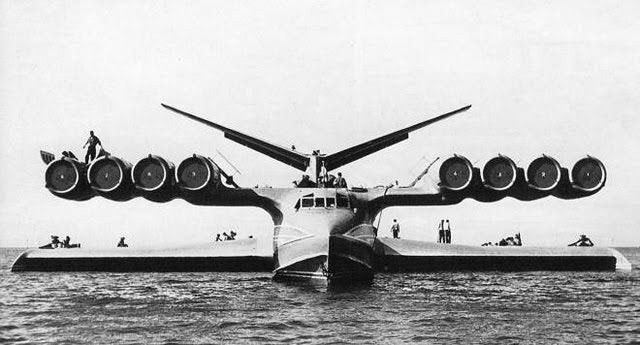
Korabl Maket (KM) – Caspian Sea Monster
At the time of its completion, the Korabl Maket Ekranoplan was the largest aircraft ever built. Travelling at over 500kph with a lifting capability of 600 tonnes, the vehicle relied on two small engines either side of its enormous tail fin to propel itself forward, although this wasn’t the most notable feature of the vehicle.
Eight huge jet engines mounted at the front of the aircraft pushed air at jet-speed underneath the wings to help generate lift and push the KM into ground effect. These huge engines were switched off once in ground effect and the tail engines kept the vehicle moving.
The KM Ekranoplan required a huge tailfin to counter turbulence, a common problem when flying in the ground effect.

A year after it’s completion, the vehicle was spotted by US spy satellites; when brought before intelligence experts, they were puzzled by the strange-looking craft, initially assuming it was an aircraft under construction.
Due to the distinctive ‘KM’ on the fuselage, the CIA designated the unknown vehicle the Kaspian Monster.
The vehicle was tested on the Caspian Sea for 15 years until, in 1980, pilot error resulted in a crash which damaged the KM irreparably and it was eventually destroyed by the authorities.
Lun-class
All was not lost for the Ekronoplan programme though, 1987 saw the introduction of a new, final vehicle. This new Lun-class Ekronoplan wasn’t quite as large as it’s predecessor, this new vessel was equipped with anti-ship missiles and advanced tracking systems.

It entered service with the Soviet Navy’s Caspian Sea Flotilla in 1987 and remained in service with the Soviet, and then Russian Navy until some time in the 1990s.
The Modern Caspian Sea Monster
The Lun-class Ekranoplan today sits unused on a beach in Southern Russia on the banks of the Caspian where it has, once again, taken the nickname the Caspian Sea Monster.
In 2020, the vessel was moved from its mooring at Kaspiysk Naval Base with a plan to install it at Patriot Park, a planned military museum in the Dagestan region of Russia displaying Russia and Soviet military equipment.

During the operation, the ekranoplan was caught in the shallows, eventually washing up onto the coast where it remains today.
It’s unclear whether or not this behemoth will ever make it to the patriot park for public display, or even perhaps one day inspire a new generation of super-heavy ekranoplan vehicles.
For now, all that remains of the Soviet Ekranoplan Programme sits on a deserted coastline. Although it is perhaps now, more than ever, a true Caspian Sea Monster.